

05/08/2026
Blog
From Molecular Simulation to Predictive Biology with HPC
Ai Shinobu, The University of Osaka
Molecular simulation has become an important part of computational biomedical research, allowing us to examine biological processes at atomic resolution. At the same time, the questions we want to address continue to push the limits of what can be computed.
To understand where these limits come from, it helps to start with the scale of the problem. Biology happens at wildly different scales at once (Figure 1A). A disease might show up at the tissue or organism level, but the underlying mechanism usually originates from structural changes in individual proteins and other biomolecules. At the molecular scale, we can use molecular dynamics (MD) simulations to study the motions of proteins and other biomolecules. In all-atom MD simulations, the motion of every atom in the system is calculated explicitly. This creates a huge gap in size between the molecular systems we can simulate and the cells in which these molecules actually function. A single cell can contain billions of protein molecules, while an individual protein may itself have thousands to tens of thousands of atoms.
Size is only one part of the problem. The time step of MD simulations is typically on the order of femtoseconds, while many of the processes we are interested in, such as conformational changes or ligand binding, occur on timescales of microseconds to milliseconds (Figure 1B). For a typical single-protein system, simulating just one microsecond using a time step of 2 femtoseconds requires 500 million MD steps, which can take 20 days on a typical lab server (Figure 1C). There is therefore a large gap in both system size and accessible timescale. Connecting molecular events to cellular function requires bridging these spatial and temporal gaps.
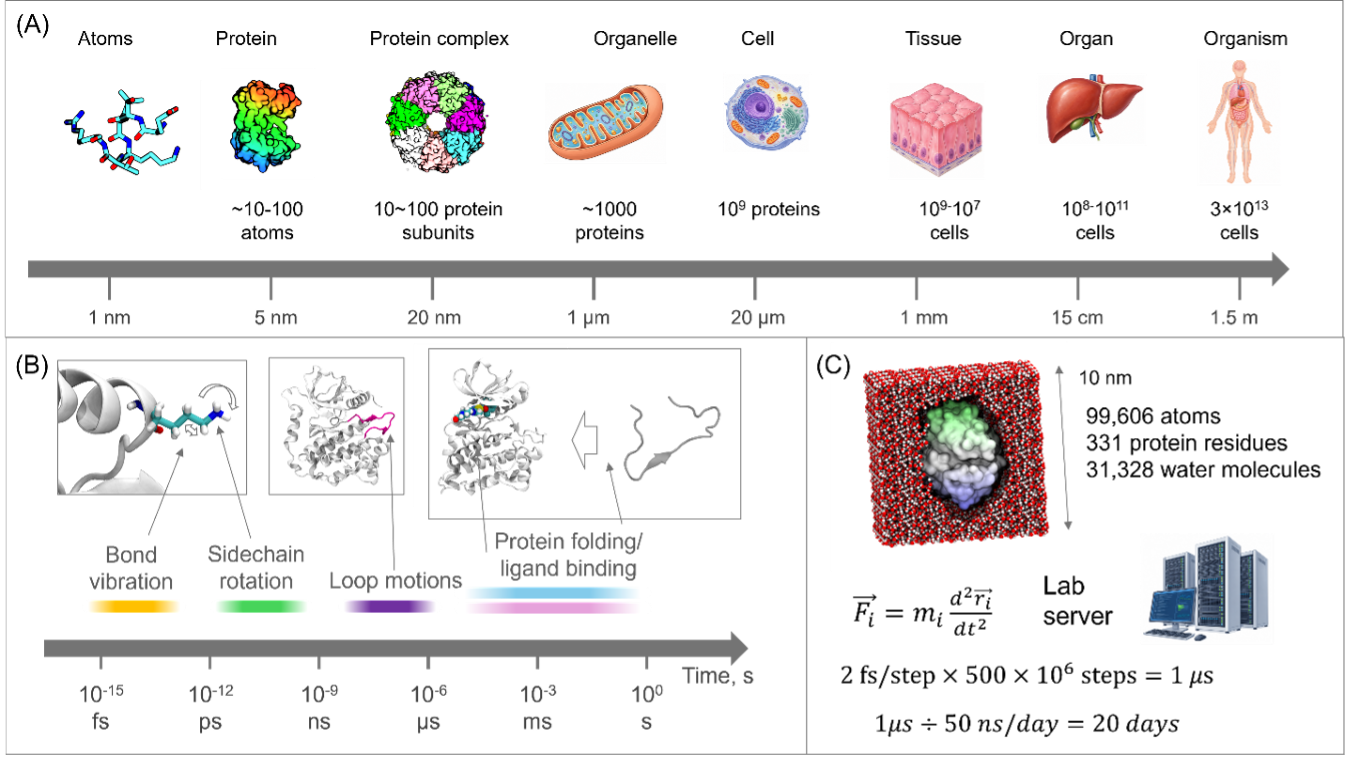
Figure 1. (A) Spatial scales of biological systems; (B) Timescales of molecular motions; (C) All-atom molecular dynamics simulation of a biomolecular system and the computational resources used for the simulation.
But size and timescale are not the only computational challenges. A single simulation trajectory rarely provides a complete mechanistic picture. An MD simulation can be thought of as an experiment performed on a computer, and just as in wet-lab experiments, rigorous computational biology requires systematic perturbation of the system. We may, for instance, want to test different mutations, protonation states, temperatures, phosphorylation sites, initial molecular conformations, and their combinations. The computational challenge is therefore not only the cost of each simulation, but also the large parameter space that needs to be explored.
Yet, advances in high-performance computing (HPC) are beginning to change what is possible with molecular simulation. Over the past two decades, growing computational power has substantially reduced the time required to perform many MD simulations. Where a study once simulated only a handful of systems, it has become increasingly common to simulate tens or even hundreds of systems and conditions within a single study. Researchers can now systematically screen panels of small-molecule inhibitors or compare the effects of many structural variants. This is an important paradigm shift: HPC is turning MD from a tool for studying individual molecular systems into a high-throughput tool for predictive hypothesis generation.
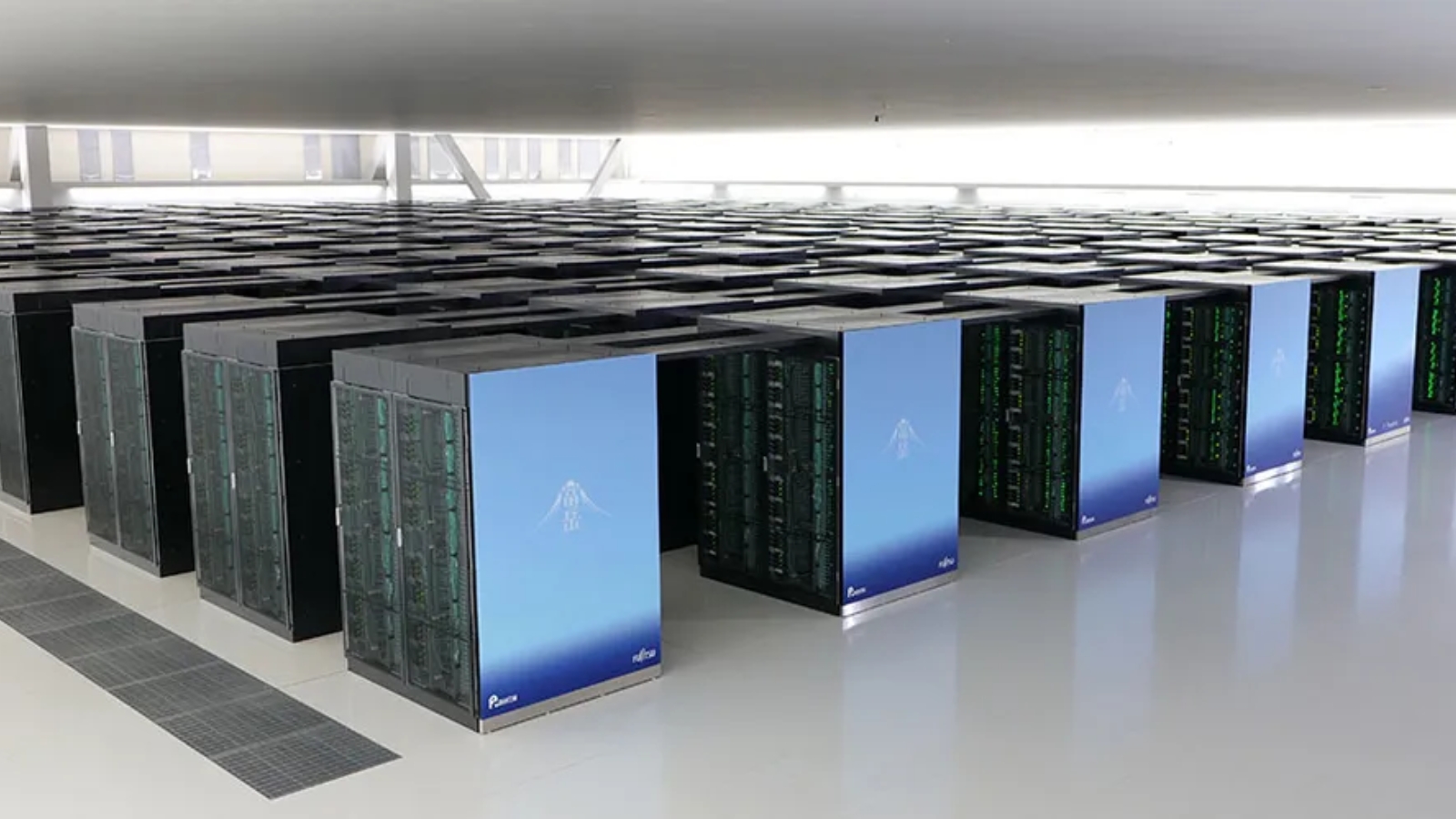
The shift in computational scale became particularly relevant during the COVID-19 pandemic. Researchers around the world redirected their efforts toward SARS-CoV-2, while computing centers made large computational resources available for COVID-19 research. One example was Japan’s Fugaku supercomputer, for which a special allocation of computing resources was made available for COVID-19 research even before the supercomputer reached full operation1. One area where these resources were used was computational drug discovery. In a virtual drug-repurposing screen, Fugaku evaluated 2,128 FDA-approved drugs against the SARS-CoV-2 main protease2. Running the screening campaign on Fugaku reduced the computational time dramatically: it finished in just 10 days, compared with an estimated full year on a conventional supercomputer.
The same urgency around COVID-19 also pushed molecular simulations toward unprecedented size and biological complexity. Alongside the search for therapeutic compounds, researchers were also trying to understand the virus itself at molecular resolution. On the Summit supercomputer, researchers built a model of the SARS-CoV-2 viral envelope containing roughly 305 million atoms, including 24 full-length glycosylated spike proteins3. In this sense, the pandemic acted as a catalyst for this shift in computational scale, expanding both the number of systems that could be explored and the size and complexity of individual simulations.
But greater computational scale is only part of the picture. Understanding a complex disease mechanism requires integrating MD simulations with omics, cellular experiments, clinical data, and machine learning. Working across disciplines also changes how computational workflows are developed. Using the same computational workflows across different research groups and computing architectures requires greater standardization and can ultimately make the methods more robust and reproducible. International collaboration adds another dimension to multidisciplinary research. Academic cultures can approach the same problem in different ways, including how hypotheses are formulated and which questions are asked. In HANAMI, collaboration between Europe and Japan also connects researchers across different HPC infrastructures, including Fugaku in Japan and LUMI in Europe. The exchange of students and early-career researchers matters just as much because the relationships they build can continue long after the project itself has ended. Those personal connections rarely develop on their own when researchers are separated by time zones and a language barrier. HANAMI bridges HPC infrastructure across Europe and Japan while building sustained connections between the two scientific communities.
What, then, comes next for computational biology? The field is already undergoing another major transition. Biology has traditionally relied on observing biological systems and perturbing them experimentally to understand how they work. Computational models increasingly allow us to ask these questions before performing the experiment. The longer-term goal is reliable prediction of biological outcomes. If we can predict how a biological system will respond to an intervention, computation can also help us search for one that produces the response we want. The question then changes from “What will happen if we make this perturbation?” to “Which perturbation will produce the desired biological outcome?”
To model biological function and disease accurately, predictive frameworks must span multiple scales, from atomic interactions up to whole organisms (Figure 2). One important part of this effort is whole-cell modeling. Built from the bottom up, these models integrate different cellular processes, including molecular interactions, metabolism, signaling, gene regulation, and responses to the environment4. Simulating an entire cell with this level of biological detail places enormous demands on computation, making whole-cell modeling an important application for HPC.
Precision medicine is a second direction, focused on individual patients rather than the population averages. Patients with the same disease can respond very differently to the same treatment. Patient-specific data can be incorporated into computational models to help predict these responses. Here the emphasis moves from cataloging patient diversity to forecasting therapeutic response. Which treatment is most likely to work for this patient? How is the disease likely to progress in this case? These are the kinds of questions precision medicine tries to answer before the outcome is known.
Digital twins bring many of these ideas together predictive computational models of biological systems or individuals. They can be built at different scales, from cells and organs to individual patients. At the patient level, such models could combine clinical measurements with detailed information about the patient’s biology5. The model starts from the current state of the system and is then used to predict what might happen next or how it might respond to an intervention. Clinicians could run virtual trials on the model to see how the patient might respond to a particular treatment. Whole-cell modeling, precision medicine, and digital twins approach the problem from different perspectives, but all move us toward computational models that can predict biological behavior.
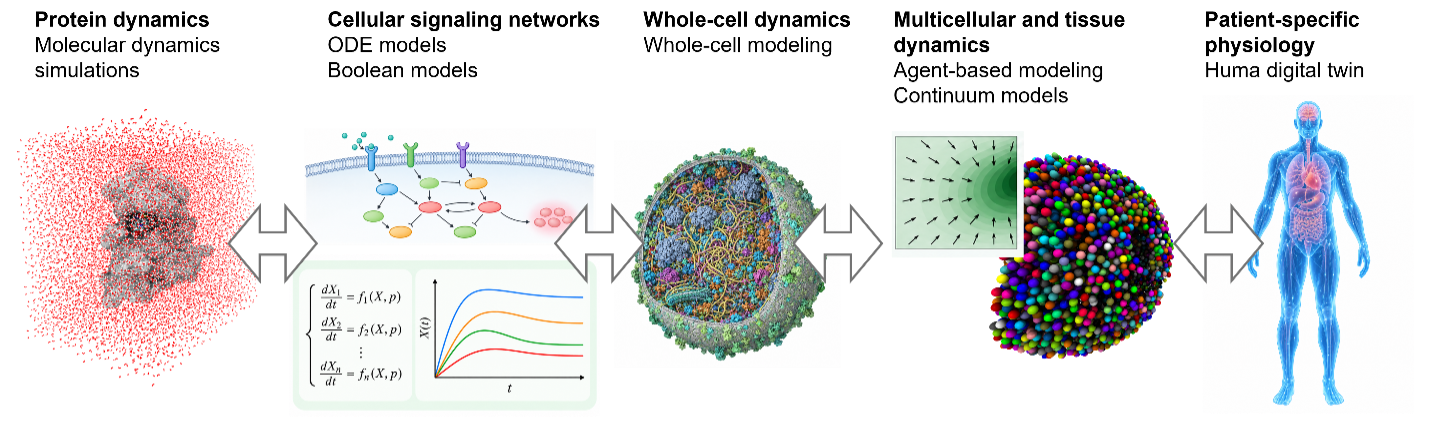
Figure 2. Multiscale computational modeling of biological systems. Molecular dynamics simulations, cellular network models, whole-cell models, multicellular and tissue models, and human digital twins across biological scales
Alongside these developments, AI is becoming an important part of predictive biology. Candidate therapeutics can now be generated computationally rather than selected only by screening existing libraries, and surrogate models can approximate calculations that once required expensive simulations. At first sight, this might suggest a future in which expensive physics-based simulations are no longer necessary. AI may reduce how often such calculations need to be repeated, but physics-based simulations are still needed to generate training data, validate predictions, and study systems that are not adequately represented by existing models. The two approaches can also work iteratively: data-driven models can identify cases where additional information is needed, and physics-based simulations can provide it. The result is not a replacement for physics-based simulations, but a different division of computational work between simulation and AI.
The increase in computational power over the recent decades has been extraordinary. We have progressed from simulations of small proteins over nanoseconds to large biomolecular complexes over microseconds and beyond. However, biological processes continue to span scales that remain far beyond our direct reach. A major challenge is therefore to extend computational modeling and simulations to larger biological systems and longer timescales without losing the level of detail needed to understand the underlying mechanisms. Paradoxically, increased computing power rarely reduces computational demand. Expanded hardware capabilities simply allow us to formulate more ambitious biological questions, driving the next generation of HPC requirements.
References
2020-21 COVID-19 Projects. RIKEN Center for Computational Science RIKEN Website https://www.r-ccs.riken.jp/en/fugaku/research/covid-19/index.html.
The World’s Fastest Computer Leading COVID-19 Research / The Government of Japan – JapanGov -. The Government of Japan – JapanGov – https://www.japan.go.jp/tomodachi/2020/autumn2020/worlds_fastest_computer.html.
Casalino, L. et al. AI-driven multiscale simulations illuminate mechanisms of SARS-CoV-2 spike dynamics. Int. J. High Perform. Comput. Appl. 35, 432–451 (2021).
Thornburg, Z. R. et al. Bringing the genetically minimal cell to life on a computer in 4D. Cell 189, 2582–2597 (2026).
De Domenico, M. et al. Challenges and opportunities for digital twins in precision medicine from a complex systems perspective. NPJ Digit. Med. 8, 37 (2025).