


13/10/2026
Blog
Driving personalised medicine through multi-physics flow simulations
By Alex Krochak (Jülich Supercomputing Centre)
Through HANAMI, researchers from Jülich Supercomputing Centre in Germany are collaborating with researchers at the RIKEN Centre for Computational Science in Japan to advance the state of the art of biomedical CFD simulations.
The goal of the joint project is to improve understanding of how viral particles travel through the respiratory tract during inhalation. Using the m-AIA CFD solver, developed at RWTH Aachen University, the team computed both flow properties and particle propagation inside and outside the breathing tract.
The simulations combine the Lattice-Boltzmann method with Lagrangian particle tracking, enabling efficient, scalable simulations across thousands of CPU ranks. This numerical code has already been successfully deployed on several world-class HPC systems, including JUPITER in Germany and FUGAKU in Japan.
Evaluating the performance of the m-AIA solver on JURECA-DC
The simulations were carried out on 2,048 CPU cores of the JURECA-DC HPC system. An unstructured Cartesian mesh was used to capture both the interior and exterior flow regions, as shown in Figure 1.

Fig.1 – Numerical mesh used for the study.
A mesh refinement study and a scaling study were also conducted to verify the accuracy and performance of m-AIA for this specific use case. The scaling study (Fig. 2) showed that, for a mesh size of 182 million cells, performance decreases drastically when using more than 200,000 particles.
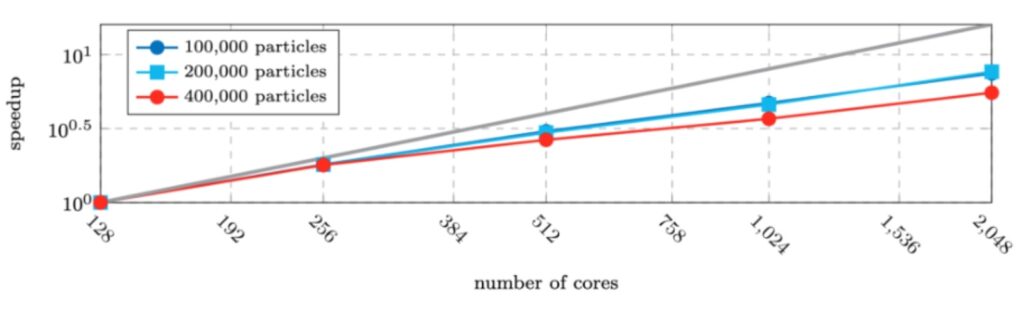
Fig. 2 – Scaling on a constant mesh with varying number of particles
Based on these results, it is recommended to initialise one particle per thousand computational cells in the mesh.
Analysing viral particle propagation during inhalation
Three initial simulations, with interior domain only, were conducted with steady-state boundary conditions corresponding to flow rates of 7.5, 15 and 30 litres per minute.
The particles were initialised at the nostrils, allowing the team to visualise particle propagation inside the breathing tract.
Additionally, the resulting deposition statistics computed show good agreement with the results obtained by Khoa et al [1], who used the same geometry with the ANSYS solver, as shown in Figure 3.
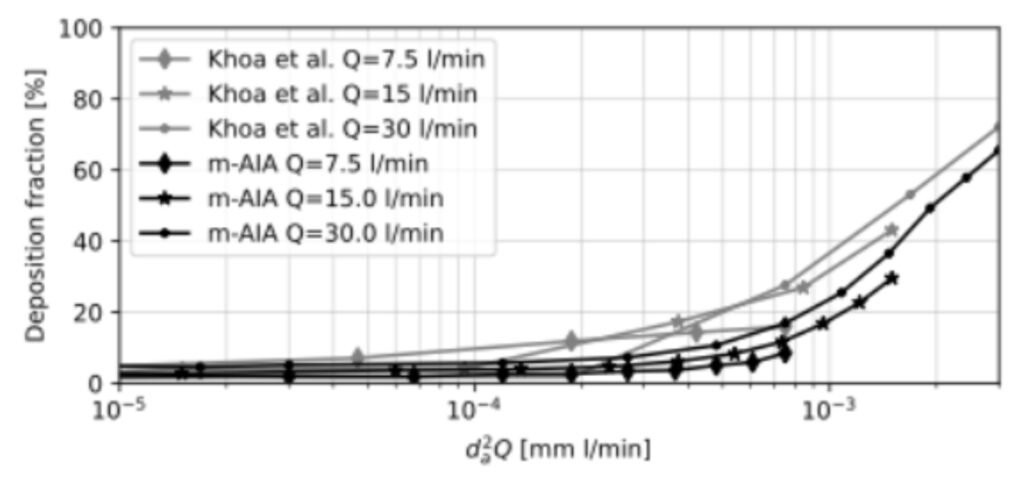
Fig.3 – Deposition rate obtained from LB-LPT simulations and from Khoa et al
Modelling complete breathing cycles in future simulations
As the project is still ongoing, the next stage will involve a fully unsteady simulation of the inhalation-exhalation breathing cycle. This will allow the team to further scrutinise the dynamics of viral particles penetrating into the breathing tract.
Reference
[1] N. D. Khoa, S. Li, N. L. Phuong, K. Kuga, H. Yabuuchi, K. Kan-O, K. Matsumoto, and K. Ito, “Computational fluid-particle dynamics modelling of ultrafine to coarse particles deposition in the human respiratory system, down to the terminal bronchiole,” Computer Methods and Programs in Biomedicine, vol. 237, p. 107589, 2023.