


13/10/2026
Blog
HANAMI on Fugaku: Accelerating HPC Research across Europe and Japan
By HANAMI’s Work Package 6
The HANAMI project continues to strengthen Europe–Japan collaboration in high-performance computing (HPC) by enabling researchers to access and optimise scientific applications on some of the world’s most advanced supercomputing infrastructures.
Through dedicated computational allocations on the Fugaku supercomputer, HANAMI partners have been able to accelerate research across multiple scientific domains. This blog post highlights selected activities carried out on Fugaku within the HANAMI project, showcasing how access to large-scale computational resources is supporting scientific discovery.
Optimising Yambo and Exploring Lead-Free Photovoltaic Materials
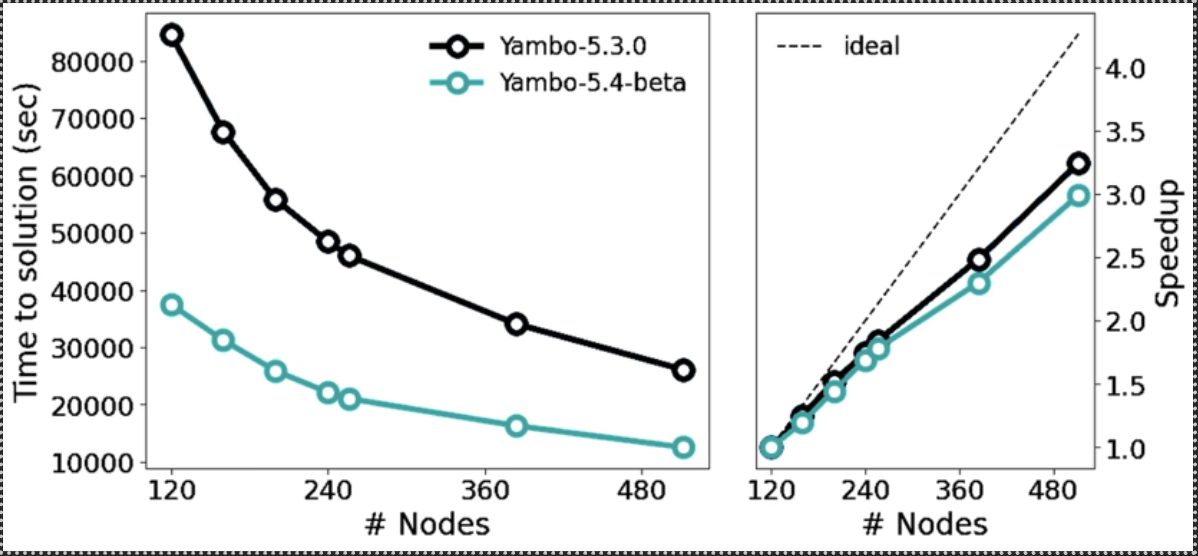
The HANAMI project’s allocation on the Fugaku supercomputer provided an important opportunity to evaluate and optimise the Yambo code within a massively parallel ARM-based architecture. Initial benchmarking using the released version of Yambo (5.3) demonstrated robust scalability for typical GW calculations, using a complex cobalt/graphene interface as a representative test case.
To fully leverage the unique capabilities of the Fugaku architecture, the team focused on optimising the OMP parallelisation and restructuring the most computationally demanding kernel: the polarizability calculation. By explicitly exposing GEMM-like operations, this new implementation, now available in the 5.4beta release, significantly reduced time to solution while maintaining high scaling efficiency. Furthermore, this structural overhaul also provides a foundation for ongoing work on reduced-precision benchmarks, a task currently being developed in close collaboration with the RIKEN team to further enhance computational throughput.
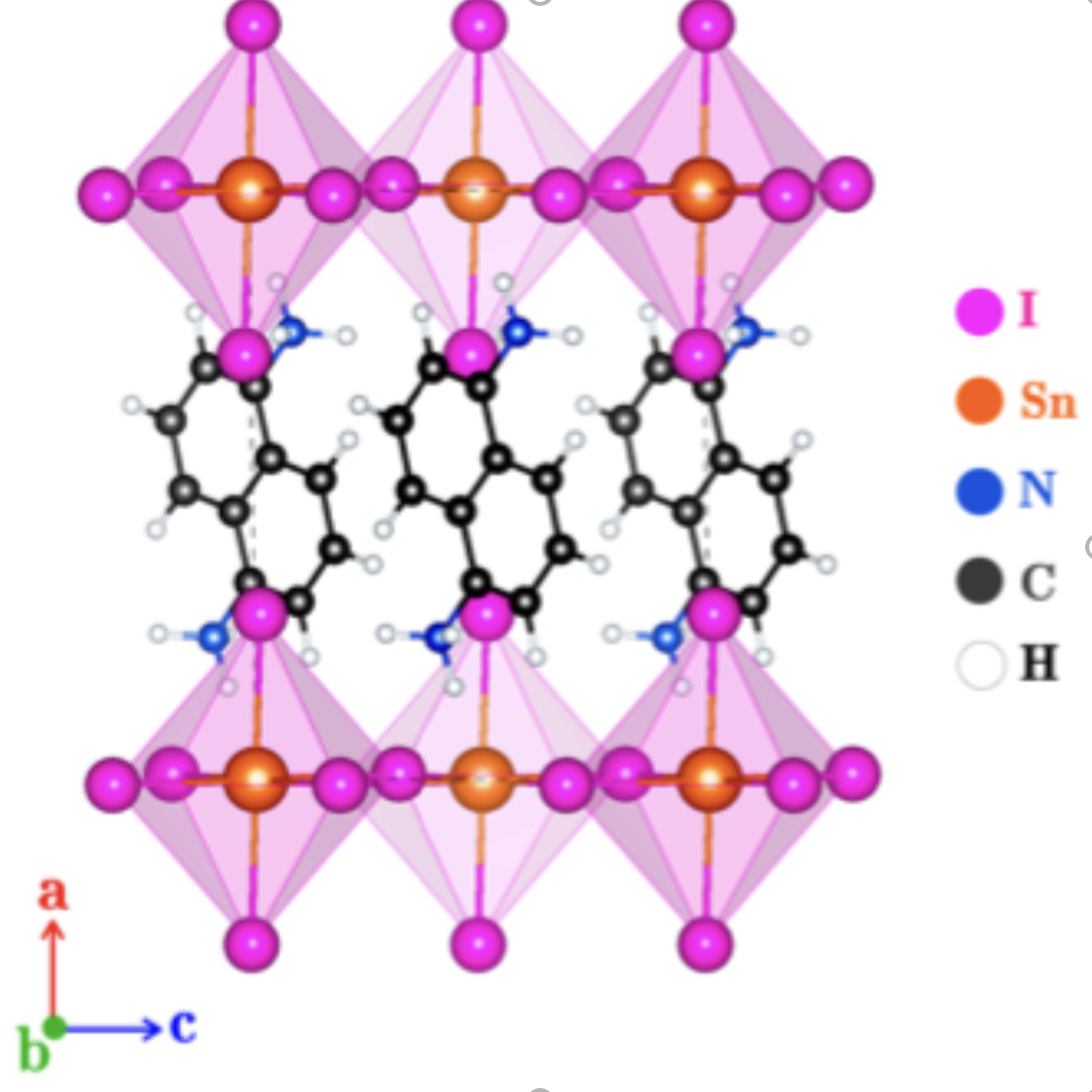
In parallel to these software optimisations, the Fugaku allocation enabled significant progress in the search for next-generation photovoltaic materials. The team conducted an in-depth study of the structural, electronic, and optical properties of a newly synthesised lead-free perovskite. This material is particularly promising for solar cell applications due to its favourable optical characteristics and inherent stability, offering a sustainable alternative that avoids the environmental impact of toxic elements commonly used in conventional perovskites, such as lead. These efforts highlight the synergy between advanced HPC and the practical goals of materials science within the Europe-Japan collaboration.
Improving Superconductivity Simulations with Diffusion Monte Carlo
Thanks to the Fugaku allocation, we generated a training set of energies and forces for a selected set of nuclear configurations using diffusion Monte Carlo (DMC) calculations. These calculations focused on LaH10, a hydrogen-rich superhydride known to host high-temperature superconductivity under high pressure.
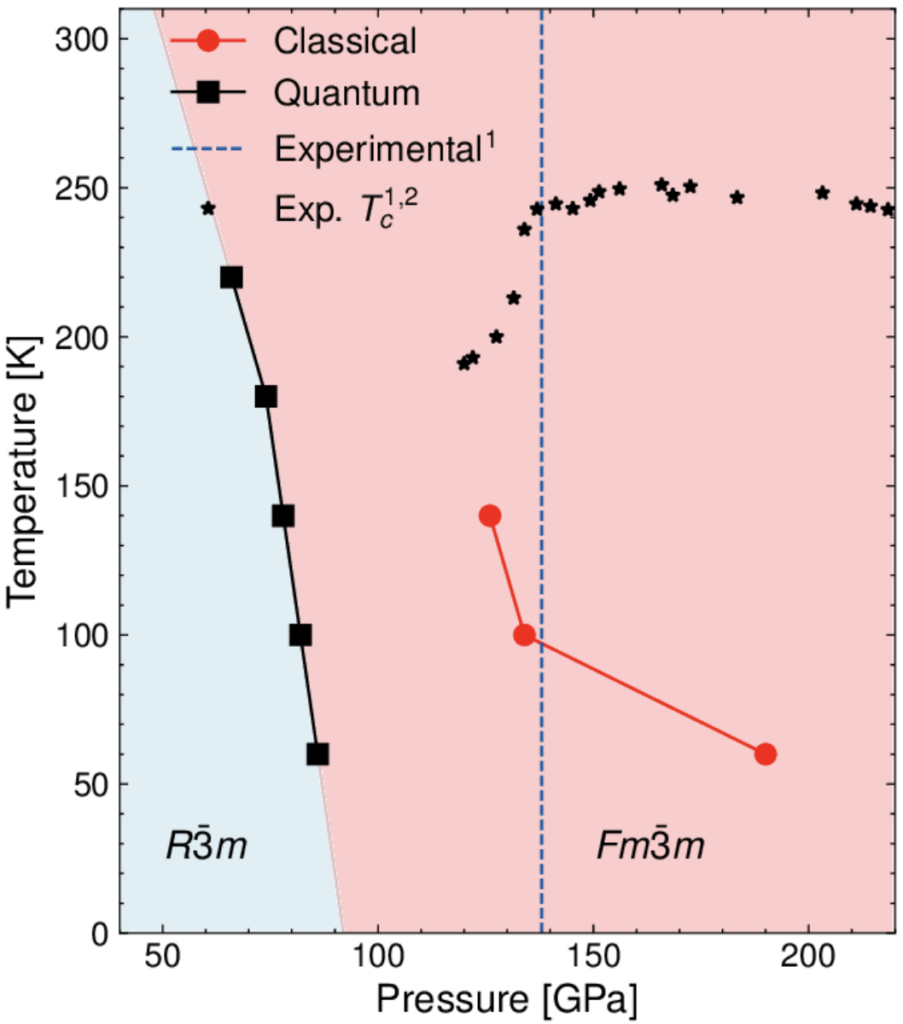
We ran DMC calculations on more than 500 ionic configurations of the LaH10 crystal, each containing 88 atoms in a periodic supercell. The corresponding energy and forces will later be used to generate a machine-learning interatomic potential (MLIP), designed to overcome the limitations of the PBE density functional. These restrictions are apparent in the figure below, where we report the experimentally measured transition pressure from the superconducting high-symmetry phase to a lower-pressure low-symmetry phase (dashed line) and the one estimated from our quantum simulations via ab initio path integral molecular dynamics (black solid line).
There is a clear discrepancy of more than 40 GPa, which is attributed to the lack of precision of the PBE potential. The generated MLIP based on our accurate DMC calculations is expected to resolve this discrepancy and make molecular dynamics more predictive and reliable for this material. The calculations were performed using the TurboRVB code, developed within the HANAMI project, in collaboration with Kosuke Nakano (NIMS, Tsukuba) and Abhishek Raghav, a former HANAMI postdoc in Michele Casula’s group, now working at RIKEN-CEMS.
Validating the ChASE Eigensolver on Fugaku
Access to the Fugaku supercomputer played an important role in advancing two of the most ambitious technical objectives pursued within the HANAMI project.
The primary achievement enabled by this allocation was the large-scale testing and validation of the new pseudo-Hermitian eigensolver developed as extension of the ChASE library. The numerical experiments executed on Fugaku’s massively parallel ARM-based architecture demonstrated that the solver delivers robust and efficient performance not only on distributed GPU systems but also on CPU-only architectures with fundamentally different designs. This is an important result that significantly broadens the deployment horizon of the library and its applicability across the diverse hardware landscape of current and future HPC facilities.
Understanding the physics and chemistry of water-in-salt electrolytes
Through the access to Fugaku, we optimised the compilation of SIESTA, one of HAMANI’s codes for materials research, for execution on Fujitsu’s A64FX architecture using native libraries and compilers.
This work supported research on one of the most critical components affecting battery performance, stability and durability: the electrolyte. In particular, we studied the structure and dynamics of water-in-salt electrolytes (WISE), which have demonstrated strong potential to reduce hydrogen evolution reactions. This helps suppress self-discharge and corrosion processes. WISE electrolytes can also extend the electrochemical stability window, enabling batteries to operate at higher voltages.
We considered the mixture of WISE electrolytes for Zn-based storage devices containing NaClO4 and Zn(ClO4)2 and water at different concentrations. Organic solvents, such as acetonitrile (CH₃CN), were added to reduce viscosity and improve ion transport. Our results have been instrumental in understanding some puzzling but promising experimental results from our collaborators.
These activities show how HANAMI is combining advanced scientific applications with software optimisation to make the most of large-scale HPC infrastructures such as Fugaku. By supporting research across materials science, quantum simulations and numerical libraries, the project continues to strengthen Europe–Japan collaboration.