

18/06/2026
Blog
Multiscale Cellular Simulations: A Foundation for Digital Twins in Personalised Medicine
By José Carbonell Caballero & Alfonso Valencia (Barcelona Supercomputing Center)
Biological systems operate across interconnected scales, from molecular interactions and signalling pathways to cellular decisions and tissue-level responses. Multiscale cellular simulations integrate these processes within a single computational framework (Ponce-de-León et al., 2023), allowing molecular mechanisms, individual cell behaviours and population dynamics to be studied together. In these models, cells are represented as computational agents that can proliferate, migrate, communicate, differentiate or die in response to neighbouring cells and their microenvironment. Each agent may also contain an intracellular model that determines how external signals are translated into phenotypic decisions. This integration enables researchers to examine how molecular perturbations propagate across scales and eventually alter the behaviour of an entire cell population.
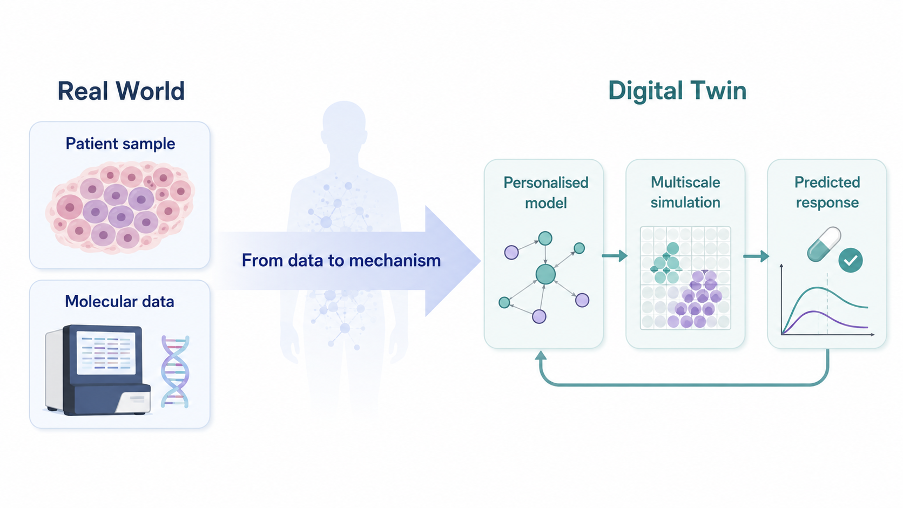
Figure 1 – From patient-derived data to a personalised digital twin. Patient samples and molecular data are transformed into mechanistic, patient-specific models that drive multiscale cellular simulations. These simulations can be used to predict treatment responses and iteratively refine the digital twin as new data become available
We envision multiscale cellular simulations as a foundation for the future digital twins of personalised medicine. Rather than static virtual copies of patients, these digital twins should be dynamic and mechanistic representations informed by patient-specific molecular, cellular and clinical data (Figure 1). They could be interrogated to explore disease progression, compare therapeutic strategies and anticipate outcomes such as treatment resistance. Multiscale simulations therefore provide a mechanistic bridge between genomic observations and cellular or tissue-level phenotypes.
Connecting Molecular Pathways to Cellular Behaviour
A crucial step towards this vision is the definition of intracellular models for each relevant cell type. Tumour, immune, stromal and endothelial cells may respond differently to the same environmental stimulus because their behaviour is controlled by distinct signalling networks, regulatory programmes and functional states. Intracellular models must therefore capture the mechanisms that determine whether a cell proliferates, becomes quiescent, migrates, secretes signalling molecules or undergoes cell death. These models can be constructed by combining data-driven inference methods and accumulated biological knowledge from curated pathway databases, experimental studies and expert interpretation of the literature.
Boolean and logic-based models are particularly attractive because they can represent large signalling networks without requiring the extensive kinetic parameterisation associated with ordinary differential equation models. Stochastic Boolean frameworks can also represent heterogeneous and probabilistic cell-fate decisions through regulatory states and transition rates. When embedded within individual cellular agents, such models connect pathway activity to observable cellular behaviours. They can therefore describe how different cell types interpret microenvironmental signals and how intracellular alterations reshape the dynamics of a simulated tissue.
Bridging Boolean Models and Molecular Dynamics
Conventional Boolean models often represent mutations as complete loss- or gain-of-function perturbations. Although useful, this abstraction cannot capture the diversity of somatic mutations observed in cancer. Two amino-acid substitutions affecting the same protein may have very different consequences: one may destabilise the protein, another may weaken a specific protein–protein interaction, and a third may alter DNA binding without completely abolishing molecular activity.
Connecting pathway models with structural modelling and molecular dynamics offers a route towards a more precise representation of these effects (Shinobu et al., 2026). Molecular dynamics simulations and related structure-based methods can estimate how a somatic mutation affects protein stability, conformational behaviour or interaction affinity. These predictions could then be translated into quantitative modifications of the transition rates or regulatory effects used in stochastic Boolean models. Instead of representing every mutation as a binary knockout, an intracellular model could therefore encode mutation-specific changes in pathway dynamics.
This would create a more direct connection between genotype and phenotype: patient variants would first be functionally annotated, their structural consequences would be estimated, and the resulting information would be used to personalise the intracellular pathway model.
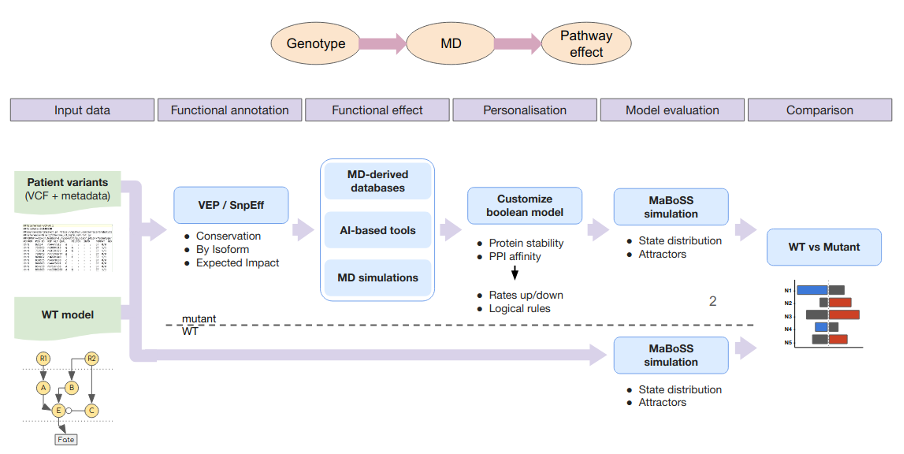
Figure 2 – Computational pipeline for assessing the effects of somatic mutations on signalling pathways using molecular dynamics. The workflow compares wild-type and mutant models by incorporating mutation-specific effects on protein stability and protein–protein interactions into the pathway model. Unlike conventional approaches that represent damaging mutations as complete protein knockouts, this strategy provides a more nuanced and mechanistically informed description of their functional consequences
This is the approach we are following in HANAMI (Figure 2) in collaboration with Japan-based collaborators Ai Shinobu and Elisa Domínguez from PRIMe Institute at Osaka University. Here, the scientific benefits are equally balanced with methodological challenges. Molecular dynamics simulations are computationally demanding, while translating structural effects into regulatory parameters requires careful calibration and experimental validation. Nevertheless, the proposed workflow offers a promising route for comparing wild-type and mutant cellular states and for predicting how specific somatic mutations may reshape tumour-cell behaviour.
LLMs as Orchestrators and Biological Interpreters
The increasing complexity of these workflows will require a new generation of computational interfaces. Large language models (LLMs) could play an important role, not by replacing mechanistic simulation tools, but by connecting and coordinating them.
Recent work by our team (Figure 3) has demonstrated that an LLM connected to specialised tools through Model Context Protocol (MCP) servers can construct and execute a multiscale modelling workflow spanning regulatory-network generation, Boolean simulation and multicellular modelling. In this architecture, the LLM serves as an interface between the researcher’s biological question and established computational software, allowing workflows to be assembled through natural-language interaction.
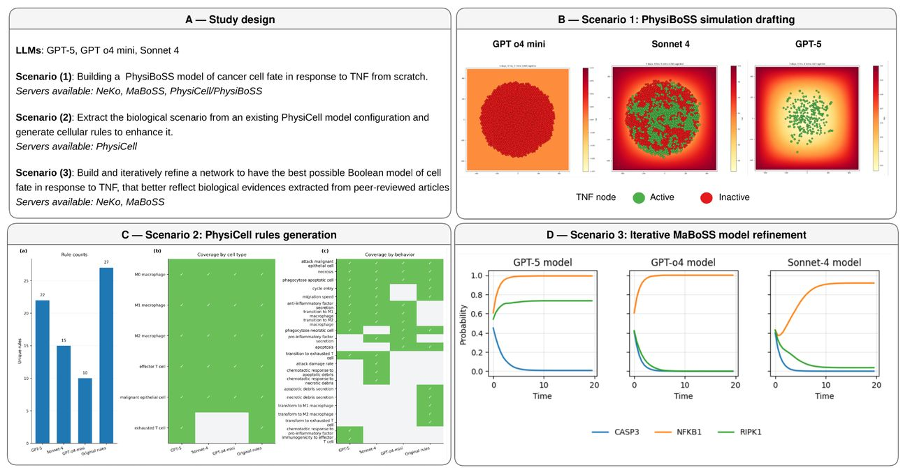
Figure 3 – Comparison of LLM-assisted mechanistic modelling across three scenarios (Ruscone et al., 2026). (A) Study design and tools. (B) PhysiBoSS models of TNF-driven cancer cell fate. (C) PhysiCell rules generated from an existing configuration. (D) Iterative refinement of MaBoSS models, showing CASP3, NFKB1 and RIPK1 dynamics. All LLMs completed the workflows, but produced differences in model structure and behaviour
Future LLM-based systems could extend this role considerably. They could orchestrate patient-data processing, structural modelling, pathway personalisation, parameter optimisation, cellular simulation and uncertainty analysis. Equally importantly, they could support the biological interpretation of simulation results by retrieving relevant literature, comparing predicted mechanisms with published evidence and identifying inconsistencies that require expert review. Their role should not be to replace mechanistic models or human judgement, but to connect them through transparent, traceable and reproducible workflows. Current LLMs may still select inappropriate parameters, misinterpret outputs or generate biologically inconsistent rules. Scientific validation, provenance tracking and human supervision must therefore remain central to their use.
Towards Mechanistic Digital Twins
The convergence of multiscale cellular simulation, literature-derived intracellular models, molecular dynamics, high-performance computing and AI-assisted orchestration provides a coherent path from patient genotype to predicted phenotype. Together, these technologies could transform digital twins from static representations into dynamic mechanistic systems capable of exploring disease progression and therapeutic response. By translating patient-specific molecular information into testable cellular and tissue-level predictions, this integrated approach will help define the future of personalised medicine.
References
Ponce-de-Leon, M., Montagud, A., Noël, V., Meert, A., Pradas, G., Barillot, E., Calzone, L., & Valencia, A. (2023). PhysiBoSS 2.0: a sustainable integration of stochastic Boolean and agent-based modelling frameworks. NPJ systems biology and applications, 9(1), 54. https://doi.org/10.1038/s41540-023-00314-4
Ruscone, M., Vazquez, M., & Valencia, A. (2026). Intelligent tool orchestration for rapid mechanistic model prototyping: MCP servers as AI-biology interfaces. NPJ systems biology and applications, 10.1038/s41540-026-00767-3. Advance online publication. https://doi.org/10.1038/s41540-026-00767-3
Shinobu, A., Nagasato-Ichikawa, A., & Okada, M. (2026). Network structures and parameters in multiscale modeling in ErbB signaling networks. Current opinion in cell biology, 98, 102603. https://doi.org/10.1016/j.ceb.2025.102603